
Graz never ceases to amaze. Between renovated Wilhelminian-era buildings, university districts, and modern urban development projects, there are places that seem as if someone had deliberately left them behind – so that nature could reclaim its place. The Graz Primeval Forest in the St. Peter district is just such a place. And it's one of the unsung stars for anyone who wants to discover habitats, not just streets and castles, during their visit to Graz.
The primeval forest is located on Messendorfberg, a relatively quiet district in the southeast of Graz. Here, you won't find a perfectly planned park, no information boards on every corner, and no hustle and bustle. Instead, you'll find a wild, almost fairytale-like forest that has retained its own unique rhythm. Large, sometimes exotic trees rise among the undulating bushes, birds call from unseen nests, and somewhere you'll hear a rustling—perhaps a dormouse or a hedgehog. Welcome to the wilderness—less than 15 minutes from Jakominiplatz.
As you walk through this piece of untouched urban nature, you'll quickly realize: This is no ordinary stroll, but a short journey back in time. To a time before paths, fences, and landscaped gardens. The Graz Primeval Forest is a rare refuge for humans and animals – and an insider tip for anyone who wants to experience Graz's wild side.
The history of the primeval forest begins not with nature, but with gardening skills: At the beginning of the 20th century, the Klennert tree nursery was located here, which was maintained until 1918 and then left to its own devices. What happened next is fascinating: Nature reclaimed the area – slowly but inexorably. For decades, the area became overgrown until the Austrian Nature Conservation Youth (ÖNJ) took over the approximately 2.8-hectare site in 1993.
Since then, the primeval forest has been managed as a so-called "eco-island" – an untouched biotope in the heart of the city. In addition to native species such as oak, maple, and elder, exotic trees such as sequoia, cedar, and spruce magnolia grow here. Many of these rarities date back to the days of the old tree nursery – vivid reminders of the area's history.
The atmosphere in the jungle is special. An almost mystical tranquility reigns among the ancient trees. No car noise, no street noise – only the cracking of branches, the chirping of birds, and your own breathing.
What makes the Graz Primeval Forest so special? It's a true nature refuge in the middle of an urban environment. Not a landscaped green space, but a small wilderness deliberately left to its own devices – with all its beauty, disorder, and diversity. This is a boon for biodiversity: During a "24-hour research day," rare animal species such as tree frogs, black woodpeckers, and even fire salamanders were documented here.
For you as a visitor, the jungle is a place to marvel and breathe deeply. Not a place to check off sights—but rather a place where you can simply let yourself go. Perfect for those who enjoy exploring off the beaten track.
The primeval forest is particularly impressive in spring, when everything sprouts – or in autumn, when the leaves turn warm colors. At the entrance, you'll be greeted by an imposing sequoia tree, whose history dates back to the imperial era. If you'd like to delve deeper, the Austrian Youth Nature Conservation Association offers regular guided tours and project days – ideal for families or small groups.
Important: Access is free, but there is no parking on site. It's best to arrive by bus or bike—and allow yourself an hour to explore.
Address:
Messendorfberg 61, 8042 Graz
Journey:
Take bus lines 72, 73U, or 76U to the "Sternäckerweg" stop. From there, it's about a 10-minute walk along a narrow path.
Please accept Statistics cookiesto view the map.
We use Leaflet.js and OpenStreetMap – a GDPR-friendly alternative to Google Maps. When you load the map, your IP address is transmitted to OpenStreetMap's servers. Leaflet itself does not store any data.
Whether hidden courtyards, quiet squares or little surprises in the middle of the city – Graz has countless corners just waiting to be discovered.
Sign up for the exploreGRAZ newsletter and find out every month which places will truly surprise you. Personally selected, lovingly described—and guaranteed, nothing off the shelf.
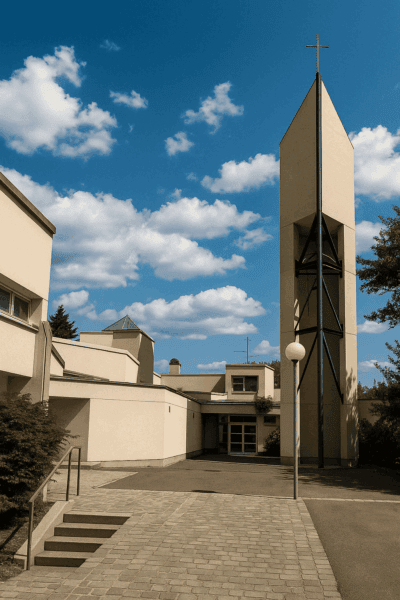
The Christus der Auferstandene church in Graz-Liebenau is a modern, open place for spirituality, art and community - with impressive architecture and a peaceful atmosphere, far away from the hustle and bustle of the old town.
Church of Christ the Risen One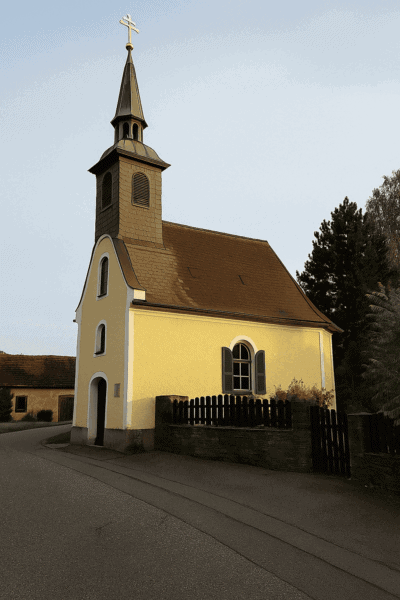
The Petersbergen local chapel is a quiet jewel in the south-east of Graz - ideal for anyone looking for peace, history and a real atmosphere when exploring the city.
Petersbergen local chapel
The parish church of Graz-St. Peter is a baroque jewel in the east of Graz - quiet, steeped in history and atmospheric. A real insider tip for anyone who wants to go off the beaten track away from the historic city centre.
Parish Church of Graz-St. Peter
Peterstalstraße in Graz-St. Peter is a quiet, charming piece of the city's history - perfect for anyone who likes to stroll, explore and experience Graz from its relaxed side.
Peterstalstrasse
The ORF Regional Studio Styria, better known as the "Peichl-Torte", is a modern round building in the east of Graz - an architectural insider tip with insights into the world of radio and television.
ORF Regional Studio Styria

 English (UK)
  Deutsch
  Italiano
  Français
  Slovenščina
  Español
  Magyar
  Čeština
  Polski